
References like MIL-STD-810F, MIL-STD-810G, and MIL-STD-810H frequently appear on technical datasheets for computers, tablets, monitors, and other ruggedized equipment built for harsh environments. However, seeing one of these acronyms is not enough to know what was tested, how severe the test was, or whether the result is relevant to your intended application.
MIL-STD-810 is an environmental engineering considerations and laboratory tests standard published by the United States Department of Defense. Its core principle is not to apply an identical battery of tests to every product, but to tailor tests to the specific environmental stresses a device will encounter throughout its service life. Therefore, when comparing two devices, reviewing the methods, procedures, and parameters applied is just as critical as knowing the standard's revision level.
In this guide, we examine the differences between MIL-STD-810F, 810G, and 810H, how to interpret a test report, and what technical decision-makers should require when selecting hardware for defense, industrial, transportation, or outdoor applications.
What is the MIL-STD-810 Military Standard and What Does It Prove?
The MIL-STD-810 military standard provides engineering guidelines and laboratory test methods to evaluate the effects of natural and induced environments on equipment. These stress factors include high and low temperatures, thermal shock, rain, humidity, salt fog, sand and dust, vibration, mechanical shock, and altitude.
The key principle is tailoring. Not every product needs to pass every test method, nor should devices be tested under identical stress levels. For example, a monitor installed in a ground vehicle faces a completely different vibration profile than a fixed display on an industrial plant floor or equipment mounted on a naval deck.
For this reason, the phrase "MIL-STD-810 certified" should be interpreted with caution. From a technical standpoint, what truly matters is knowing which laboratory performed the test, which test sample was evaluated, which method and procedure were followed, what test levels were applied, and what criteria determined a passing result.
Comparison Between MIL-STD-810F, MIL-STD-810G, and MIL-STD-810H
All three revisions share the underlying philosophy of reproducing relevant environmental stress factors under controlled laboratory conditions. The evolution between versions refines environmental characterization, updates test procedures, and strengthens the link between real-world operational profiles and test plans.
| Version | Initial Publication | Key Takeaways |
| MIL-STD-810F | 2000 | Consolidated the environmental tailoring process throughout the equipment lifecycle and expanded guidance for test planning. |
| MIL-STD-810G | 2008 | Updated test methods, environmental data, and procedures; Change 1 was published in 2014. |
| MIL-STD-810H | 2019 | The most recent revision; Change 1 (2022) is the active document, expanding and refining various test methods. |
A newer revision does not automatically make a product more rugged. A properly tailored test conducted under an older revision can be far more meaningful than a generic compliance statement based on the latest version. A valid comparison requires reviewing the actual scope of testing.
MIL-STD-810F: Driving the Push for Environmental Test Tailoring
Revision F, published in January 2000, placed a stronger emphasis on the environmental tailoring process. Its goal was to align design criteria and testing conditions directly with the actual operational, storage, transport, and maintenance environments the equipment would face.
MIL-STD-810F clearly structured the responsibilities of program managers, environmental specialists, design engineers, and testing laboratories. It also stressed that test methods should not be applied indiscriminately or treated as fixed, static routines.
You can still find equipment tested under this revision, particularly products with long lifecycles. This does not invalidate the test results, but it does require verifying whether the chosen procedures and severity levels remain representative of your current project requirements.
MIL-STD-810G: Updated Methods and Greater Documentation Precision
MIL-STD-810G, published in October 2008, maintained the lifecycle-based approach while updating a large portion of the test methods. Revision G and its Change 1 (2014) became widely adopted benchmarks across military, industrial, and rugged commercial hardware.
In practice, many product datasheets reference MIL-STD-810G without further elaboration. However, such a reference only carries value when accompanied by specifics, such as "Method 514.6, Procedure I" for vibration or "Method 516.6" for shock, along with stress levels, axes, duration, mounting configuration, and operational status during testing.
If a product listing only displays a logo or the generic acronym, buyers cannot determine whether a production unit, a prototype, or merely a sub-assembly was tested. Nor can they verify whether the test replicates their intended application.
MIL-STD-810H: The Active Military Standard Revision
MIL-STD-810H was released in January 2019, followed by Change 1 incorporated in May 2022. It is the active revision, continuing the evolution of environmental engineering with refined guidance and updated laboratory methods.
Revision H reinforces the need to start with a realistic environmental profile and thoroughly document tailoring decisions. Consequently, simply asking for "MIL-STD-810H compliance" without defining the operational scenario remains insufficient. A proper test plan must translate the intended use into measurable temperatures, durations, cycles, vibration profiles, shock forces, and other stress factors.
For new developments, utilizing the active revision makes it easier to align requirements, laboratory capabilities, and documentation. Nevertheless, selection decisions should consider contracts, complementary industry standards, legacy configurations, and compatibility with previously validated test data.
How to Interpret a MIL-STD-810G or MIL-STD-810H Test Report
An actionable test report makes it possible to reconstruct what happened before, during, and after testing. When reviewing a report, verify at least the following elements:
Revision, Method, and Procedure:References must be complete, rather than a generic claim of standard compliance.
Sample Configuration:Model, components, connectors, mounting setup, accessories, and software must match the delivered equipment.
Levels and Duration:Temperature ranges, frequency, acceleration, cycle counts, or exposure times determine the actual severity.
Operational State:It is essential to know whether the unit was powered off, fully operational, or actively monitored during testing.
Acceptance Criteria:Verified functions and allowable performance thresholds before and after the test must be clearly defined.
Laboratory and Traceability:Dates, measurement equipment, calibration data, anomalies, and test results build trust in the document.
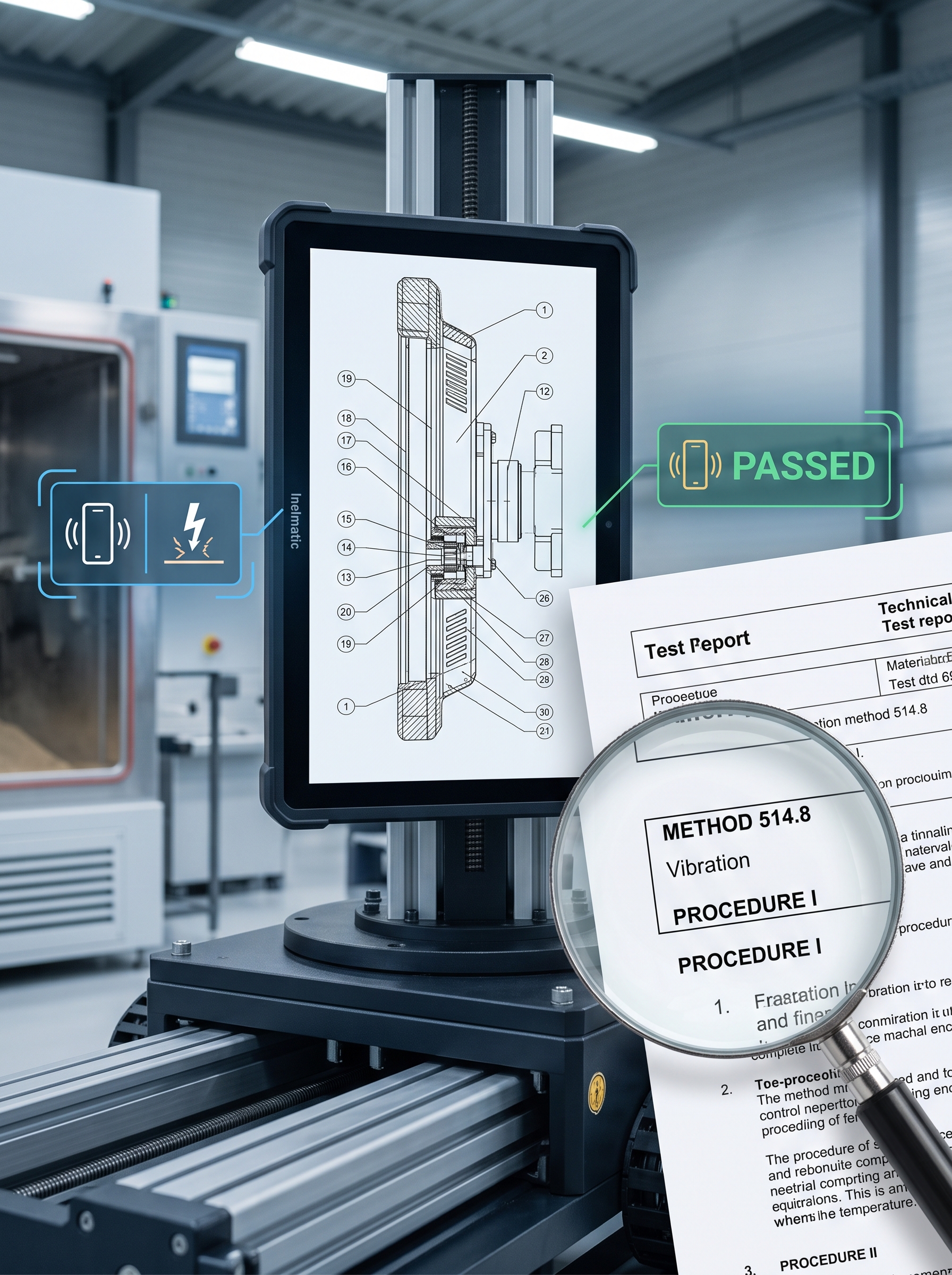
This information enables direct comparisons between alternatives and exposes overly broad claims. It also helps determine whether re-testing is necessary if changes are made to the display, enclosure, electronics, power supply, or mounting brackets.
Which MIL-STD-810 Revision Should You Choose for Rugged Equipment?
For a new project, MIL-STD-810H is usually the primary reference point because it is the active revision. However, project specifications may explicitly call for MIL-STD-810G, an existing platform may already be validated under Revision G, or the end customer may specify test methods from an earlier revision.
The correct choice should not be treated as a competition between letters. First, identify the environment: where the equipment will be installed, how it will be transported, what thermal extremes it will encounter, what vibration profiles it will absorb, whether it faces rain or dust exposure, and its required operating lifespan. Then, select appropriate methods, procedures, and severity levels.
In mission-critical applications, it may also be necessary to combine MIL-STD-810 testing with electromagnetic compatibility (EMC), power supply compliance, IP ingress ratings, sunlight readability, flammability, or industry-specific standards for rail, marine, or automotive sectors.
MIL-STD-810 in Rugged Displays and Ruggedized Monitors
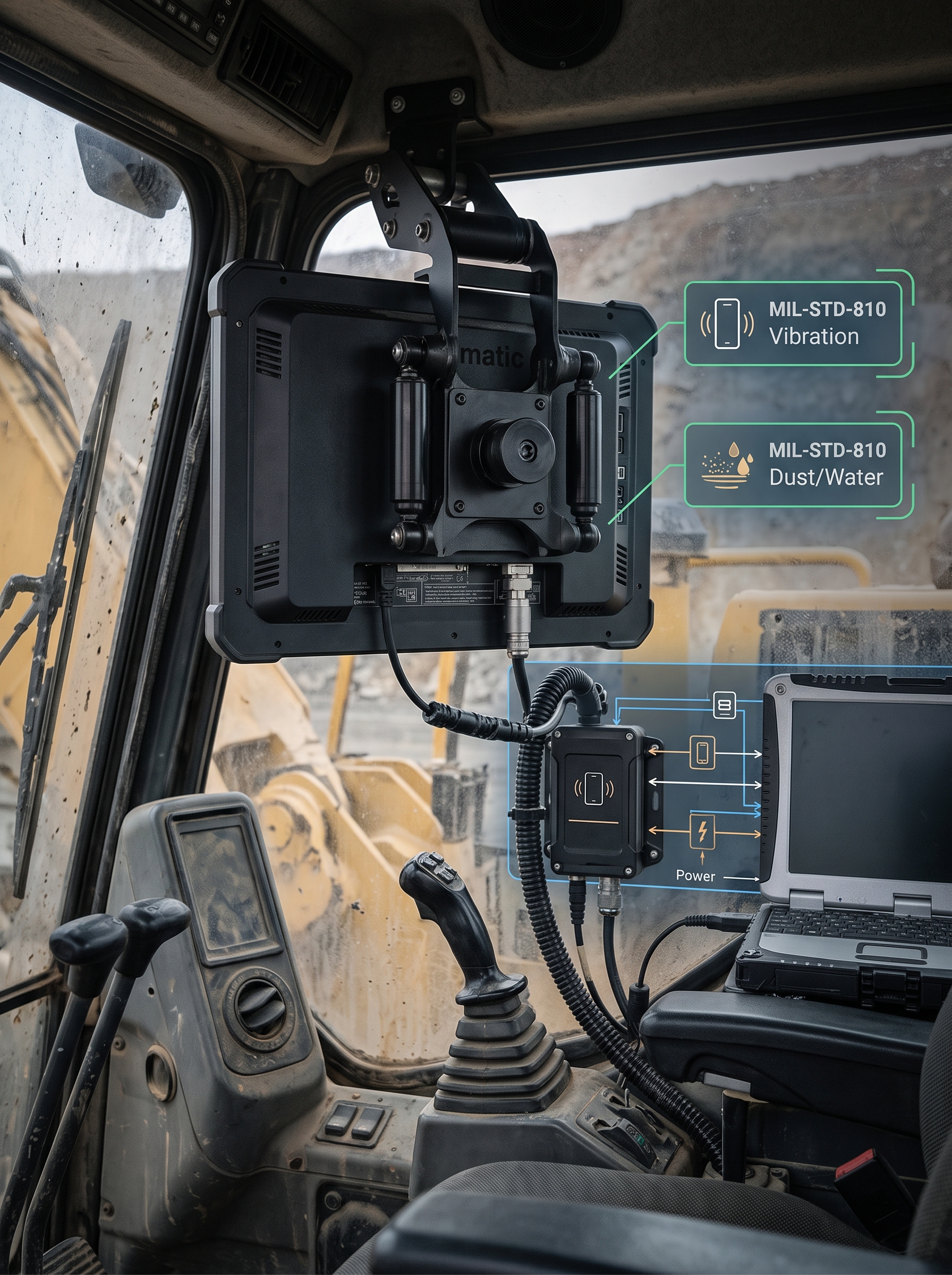
In a display system, durability depends on much more than the LCD panel. The enclosure, front glass, mounting mechanisms, circuit boards, connectors, seals, thermal management, and vehicle/machine integration all play vital roles.
Inelmaticmilitary-grade displays and monitorsare built to perform in environments exposed to dust, moisture, severe vibration, impacts, and extreme temperatures. For instance, the PR Series incorporates MIL-STD-810 shock and vibration testing, paired with steel/aluminum construction and optional front glass protection.
For other deployment scenarios,Inelmatic's rugged displaysallow engineers to combine metal housing, resistive or capacitive touchscreens, sealed enclosures, and optical enhancements. This customization capability is critical, as the test plan must match the exact hardware configuration deployed in the field.
Beyond hardware selection, involving Inelmatic's electronic engineering team early in the process helps define interfaces, power supplies, thermal management, and validation criteria. In custom projects, designing with testing in mind reduces iteration cycles and prevents late-stage design modifications from invalidating prior test evidence.
Inelmatic's experience delivering solutions for industrial, transportation, defense, and maritime sectors enables a complete systems approach rather than treating the display as an isolated component.
Common Mistakes When Comparing MIL-STD-810F, 810G, and 810H
The primary mistake is assuming that referencing a revision implies passing all of its test methods. A second mistake is comparing revision letters while ignoring test severity. It is also common to accept test reports conducted on a different hardware configuration, ignore mounting systems, or confuse a manufacturer's internal test with a comprehensive certification issued by an independent authority.
Another frequent error is requiring excessively severe test parameters with no relation to real-world operating conditions. This practice inflates development costs, adds unnecessary bulk, and wastes time without mitigating actual risks. Environmental engineering focuses on realism and traceability—not accumulating logos.
The best technical specification explicitly states the revision level, test methods, procedures, stress levels, test sequence, hardware configuration, and acceptance criteria. This establishes a verifiable baseline for engineering, testing, and comparison.
Frequently Asked Questions About MIL-STD-810F, 810G, and 810H
Which is the most recent version, MIL-STD-810G or MIL-STD-810H?
MIL-STD-810H is the active revision. It was published in 2019 with Change 1 incorporated in 2022. MIL-STD-810G was published in 2008, with Change 1 released in 2014.
Is a MIL-STD-810H product always better than a MIL-STD-810G product?
Not necessarily. You must compare the specific methods, procedures, stress levels, and test configurations. A newer revision tag with a limited test scope offers less proof of durability than a well-tailored, thoroughly documented test plan under an earlier revision.
Is MIL-STD-810 a mandatory certification?
It is a standard of test methods and environmental engineering guidelines. Mandatory compliance depends on contract requirements or procurement specifications. It is best to request actual test reports and verify the specific testing scope rather than relying on the word "certified."
Which MIL-STD-810 tests are typical for a rugged monitor?
This depends on the application, but common tests include vibration, shock, high/low operational temperature, humidity, rain, dust, and salt fog. Only methods that reflect the lifecycle risks of the equipment should be selected.
Must MIL-STD-810 testing be repeated if the screen or enclosure changes?
The impact of the modification must be evaluated. Alterations in mass, structural rigidity, mounting points, glass type, internal electronics, or thermal design can change performance under stress and may justify partial or full re-testing.
What documentation should a rugged display supplier provide?
At a minimum, the supplier should provide sample identification, the standard revision, test methods and procedures, applied stress levels, duration, mounting setup, operational status, acceptance criteria, test results, and any logged anomalies.